Winnipeg · ManitobaA community statement on the events of 1948
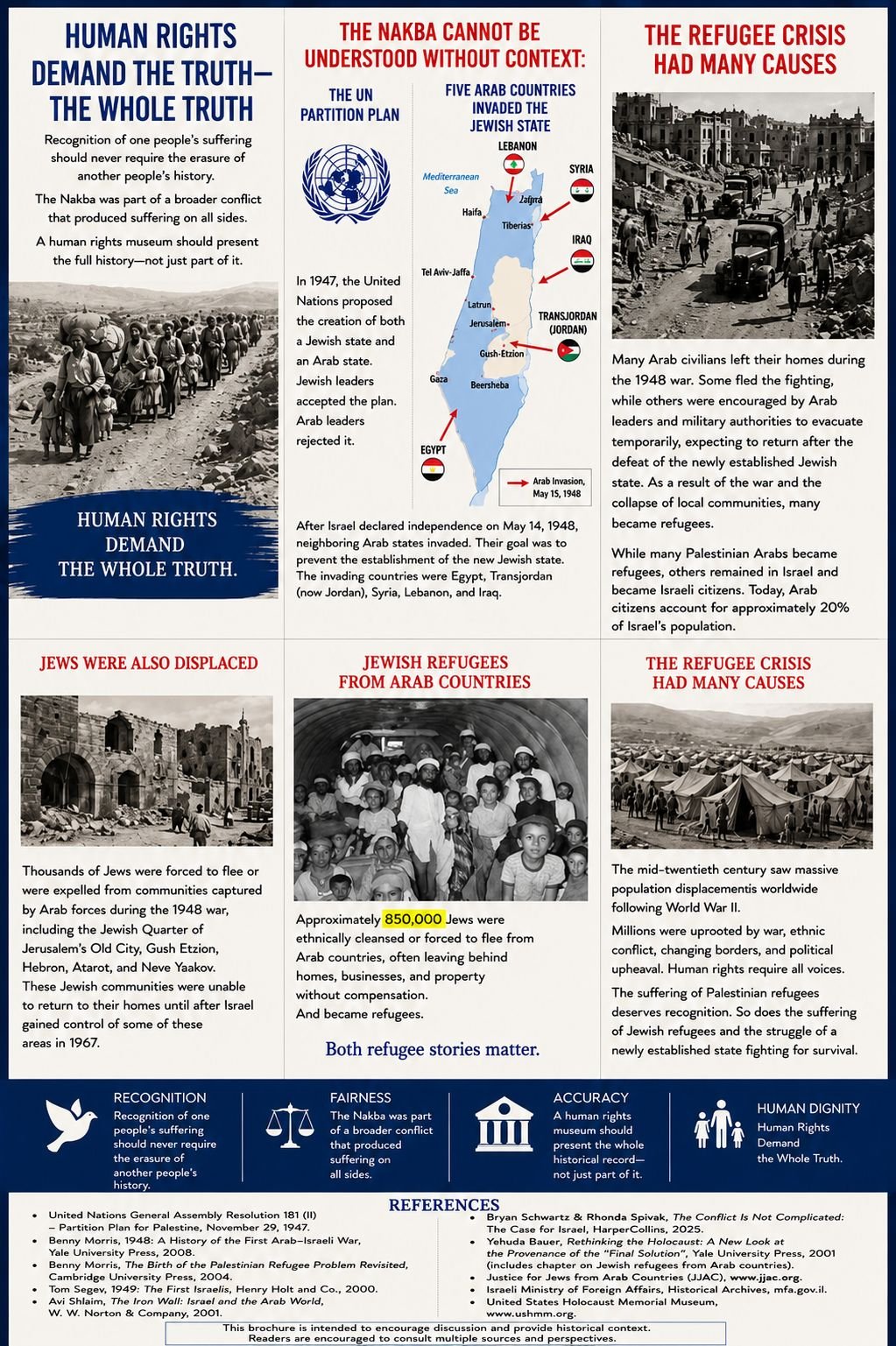
Human Rights Demand the Whole Truth
Recognition of one people's suffering should never require the erasure of another people's history.
History Matters
A Statement to the Canadian Museum for Human Rights.
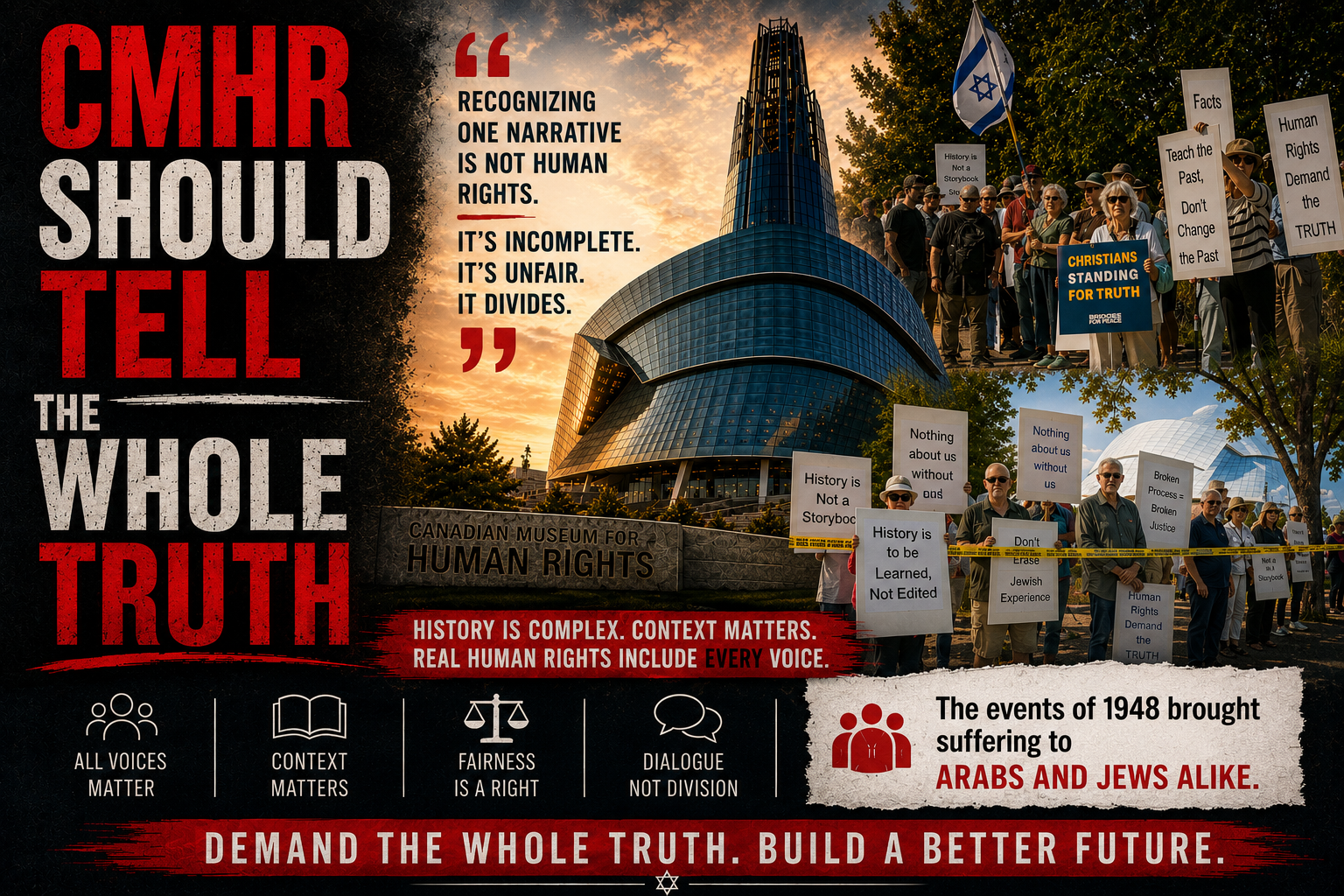
A human rights museum has a responsibility to present the full history — not just part of it.
The exhibition Palestine Uprooted: Nakba Past and Present presents one perspective on a deeply complex history. Our concern is not that the Palestinian narrative is included, but that it is is presented without the broader historical context and multiple perspectives essential to meaningful human rights education and critical thinking.
The composition of the exhibition's advisory committee raises legitimate questions about the balance and credibility of the consultation process, particularly given that some publicly associated individuals have been criticized for antisemitic social media activity. Equally concerning is that the Canadian Museum for Human Rights developed this controversial exhibition without meaningful consultation with the organized Jewish community, whose history and lived experiences are directly connected to the subject.
As Canada's national human rights museum, the Canadian Museum for Human Rights has a responsibility to present balanced, historically grounded exhibitions that encourage visitors to examine evidence, consider different perspectives, and reach their own informed conclusions.
At a time when antisemitism has reached record levels in Canada, the Museum's approach is especially troubling. Rather than fostering dialogue and mutual understanding, this exhibition risks deepening divisions and undermining public confidence in the Museum as a trusted institution committed to fairness, inclusion, and intellectual integrity.
Human rights education should reflect the full complexity of history—not a single narrative. Our concern is simple: what has been omitted from this exhibition is just as important as what has been included. A human rights museum should ensure that all relevant voices are heard so visitors can engage with history thoughtfully, critically, and with a fuller understanding of the issues.
Why this Matters
History cannot be understood through a single narrative. It requires context, multiple perspectives, and the willingness to think critically.
The events of 1948 had profound consequences for both Arabs and Jews
01
The 1947 United Nations Partition Plan
The General Assembly adopted Resolution 181, proposing two states — one Jewish, one Arab — with Jerusalem under international administration.
02
The rejection of the plan by Arab leaders
Jewish leaders accepted partition despite reservations. Arab leaders and surrounding states rejected it and opposed a Jewish state in any part of Palestine.
03
The invasion of the newly established State of Israel
On 15 May 1948, the armies of Egypt, Transjordan, Syria, Lebanon, and Iraq invaded to prevent the implementation of the partition plan.
04
The displacement of both Arabs and Jews
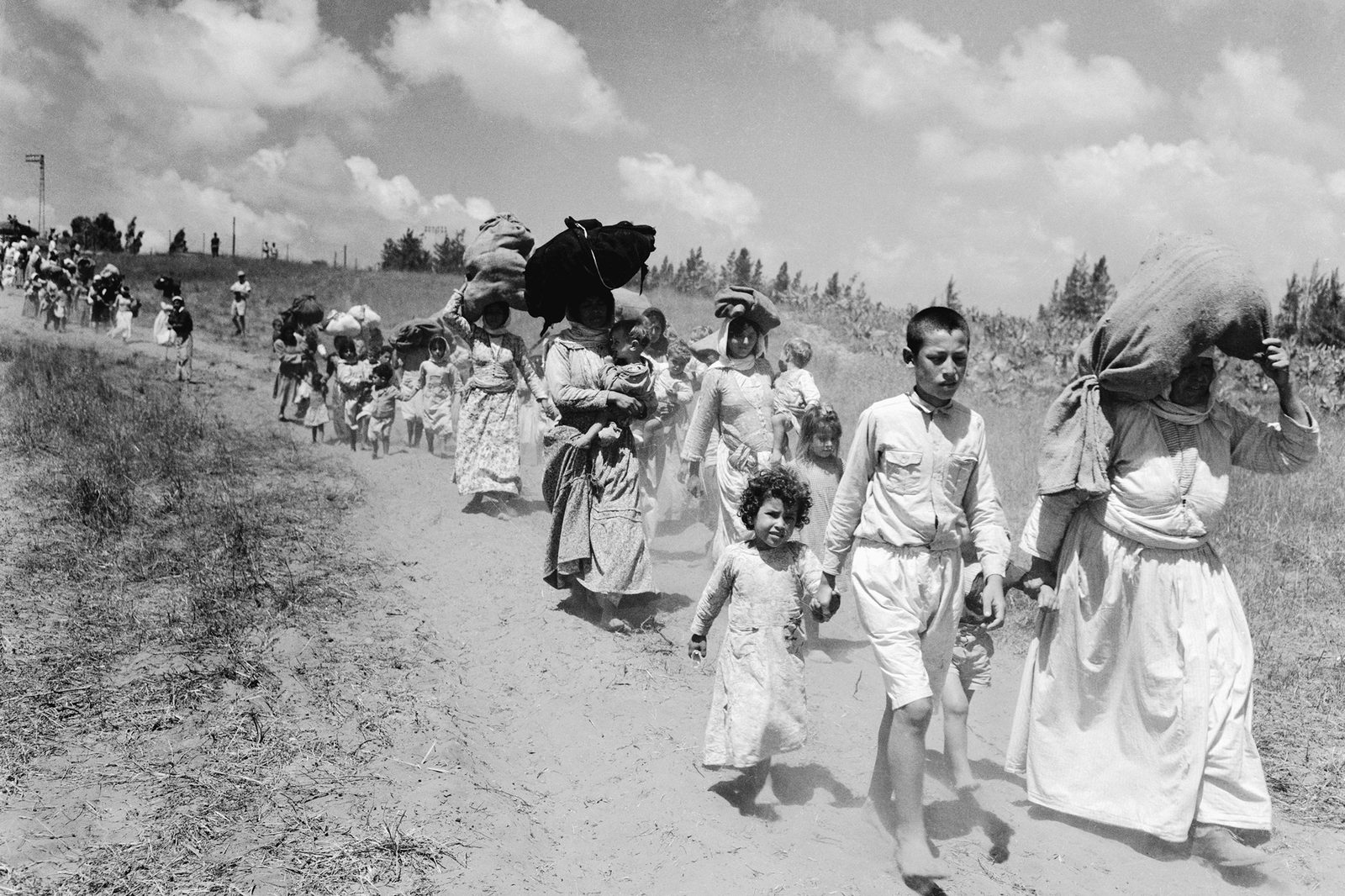
Hundreds of thousands of Palestinian Arabs became refugees; Jewish communities in areas captured by Arab forces were also uprooted.
05
The flight and expulsion of roughly 850,000 Jews from Arab countries
In the decades surrounding Israel's establishment, ancient Jewish communities across the Middle East and North Africa disappeared.
06
The global refugee crisis after World War II
The Palestinian displacement occurred amid some of the largest population movements in history, yet its refugee status uniquely persisted across generations.
The Refugee Crisis Had Many Causes
Two displacements. One war.
Both refugee stories matter. A complete account of 1948 cannot tell only one of them.
Arab Refugees
Hundreds of thousands Arabs uprooted
Many Palestinian Arabs left their homes during the 1948 war. The causes varied from place to place — active combat, the collapse of local leadership, expulsions in some locations, and fear amid a rapidly changing battlefield. Around 150,000 Arabs remained and became Israeli citizens; today Arab citizens make up roughly 20% of Israel's population.
Jewish Refugees from Arab and Muslim Countries
The displacement of ancient Jewish communities
Following the establishment of Israel, conditions for Jews across the Arab world deteriorated rapidly — riots, discriminatory laws, arrests, and confiscation of property. Communities that had existed for centuries in Iraq, Yemen, Egypt, Libya, Syria, and across North Africa largely vanished within a generation.
~850,000
Jews fled, were expelled, or were displaced from Arab and Muslim lands.
We are not asking that Palestinian suffering be ignored. We are asking that the full story be told.
Historical Context
Understanding the events of 1948
Causes, consequences, and the context in which these events occurred.
The Nakba: origins, meaning, and historical development
The Arabic word Nakba (النكبة) means "catastrophe" or "disaster." Today it is commonly used to describe the displacement of Palestinian Arabs during the 1948 Arab-Israeli War and the broader loss of Palestinian society, villages, and political aspirations that accompanied the war.
The front cover of Constantin Zureiq's 1948 book Ma'na al-Nakba, which coined the term Nakba for the Palestinian catastrophe.
The term was popularized by Syrian historian and Arab nationalist Constantin Zureiq, who published a book in August 1948 titled Ma'na al-Nakba ("The Meaning of the Catastrophe"). Zureiq used the term not only to describe the refugee crisis but also what he viewed as the political and military failure of the Arab world to prevent the establishment of the State of Israel.
In its earliest usage, the Nakba referred broadly to the outcome of the 1948 war, including the defeat of the Arab armies and the failure of Arab leadership. Over time, particularly from the 1960s onward, the meaning became increasingly associated with the displacement and suffering of Palestinian refugees and the loss of their homes and communities.
On November 29, 1947, the United Nations General Assembly adopted Resolution 181, approving the partition of Mandatory Palestine into two states — one Jewish and one Arab — with Jerusalem placed under international administration.
The United Nations General Assembly adopted Resolution 181, approving the partition of Mandatory Palestine into two states, with Jerusalem placed under international administration.
Jewish leaders accepted the UN partition plan despite reservations about the proposed borders. Arab leaders and the surrounding Arab states rejected the plan and opposed the creation of a Jewish state in any part of Palestine. The rejection was followed by escalating violence between Jewish and Arab communities, ultimately leading to the 1948 Arab-Israeli War.
Map of the United Nations Partition Plan (Resolution 181), adopted November 29, 1947. The plan called for a Jewish state (blue) and an Arab state (orange) in Mandatory Palestine, with Jerusalem administered internationally.
On May 14, 1948, David Ben-Gurion proclaimed the establishment of the State of Israel, following the end of the British Mandate. The following day, the armies of Egypt, Transjordan, Syria, Lebanon, and Iraq invaded the newly established state, with the stated objective of preventing the implementation of the UN partition plan.
Arab forces mobilize against the newly established State of Israel, May 1948.Israeli soldiers during the 1948 War of Independence.
The war lasted until 1949 and resulted in significant loss of life, territorial changes, and large-scale displacement of civilians. For Israelis, the conflict is known as the War of Independence, marking the establishment and survival of the Jewish state. For Palestinians, it is remembered as the Nakba, reflecting the loss of homes, communities, and the emergence of the refugee crisis. Understanding both perspectives is essential to understanding the conflict and its lasting impact.
Arab refugees
One of the most significant consequences of the war was the displacement of hundreds of thousands of Palestinian Arabs. According to historian Benny Morris, no single explanation accounts for the departure of all Palestinian refugees; the exodus resulted from a combination of factors that differed across regions and stages of the war — active combat, the collapse of local leadership, the departure of elites, military operations including expulsions in some locations, evacuation encouragement from Arab leaders in certain areas, and fear generated by a rapidly changing battlefield.
What is not disputed is that many Palestinians lost their homes, property, and communities. At the same time, approximately 150,000 Arabs remained within Israel's borders and became citizens — today around 20% of the country's population.
Jewish communities displaced during the war
The war resulted not only in the displacement of Palestinian Arabs but also in the destruction of several long-established Jewish communities. As Arab armies advanced, thousands of Jews were forced to flee or were expelled from territories captured by Arab forces.
Residents leave a Jewish neighbourhood under threat during the war.The fall of the Jewish Quarter of Jerusalem's Old City, May 1948.
The Jewish Quarter of Jerusalem's Old City
Following months of siege, the Jewish Quarter fell to the Arab Legion of Transjordan in May 1948. The remaining Jewish residents were expelled, and centuries of continuous Jewish presence came to an end. Many synagogues were damaged or destroyed. The Quarter remained inaccessible to Jews until 1967.
Gush Etzion
The bloc of communities south of Jerusalem was attacked repeatedly. In May 1948, Kfar Etzion fell and many of its defenders were killed after surrendering. The surviving residents were taken prisoner, and the remaining communities were evacuated. The area remained under Jordanian control until 1967.
Hebron, Atarot and Neve Yaakov
Although the ancient Jewish community of Hebron had largely been destroyed following the 1929 massacre, the 1948 war prevented the return of residents. The communities of Atarot and Neve Yaakov, north of Jerusalem, were abandoned during the fighting after coming under attack and being isolated from Jewish-controlled areas.
The forgotten refugees: Jews from Arab countries
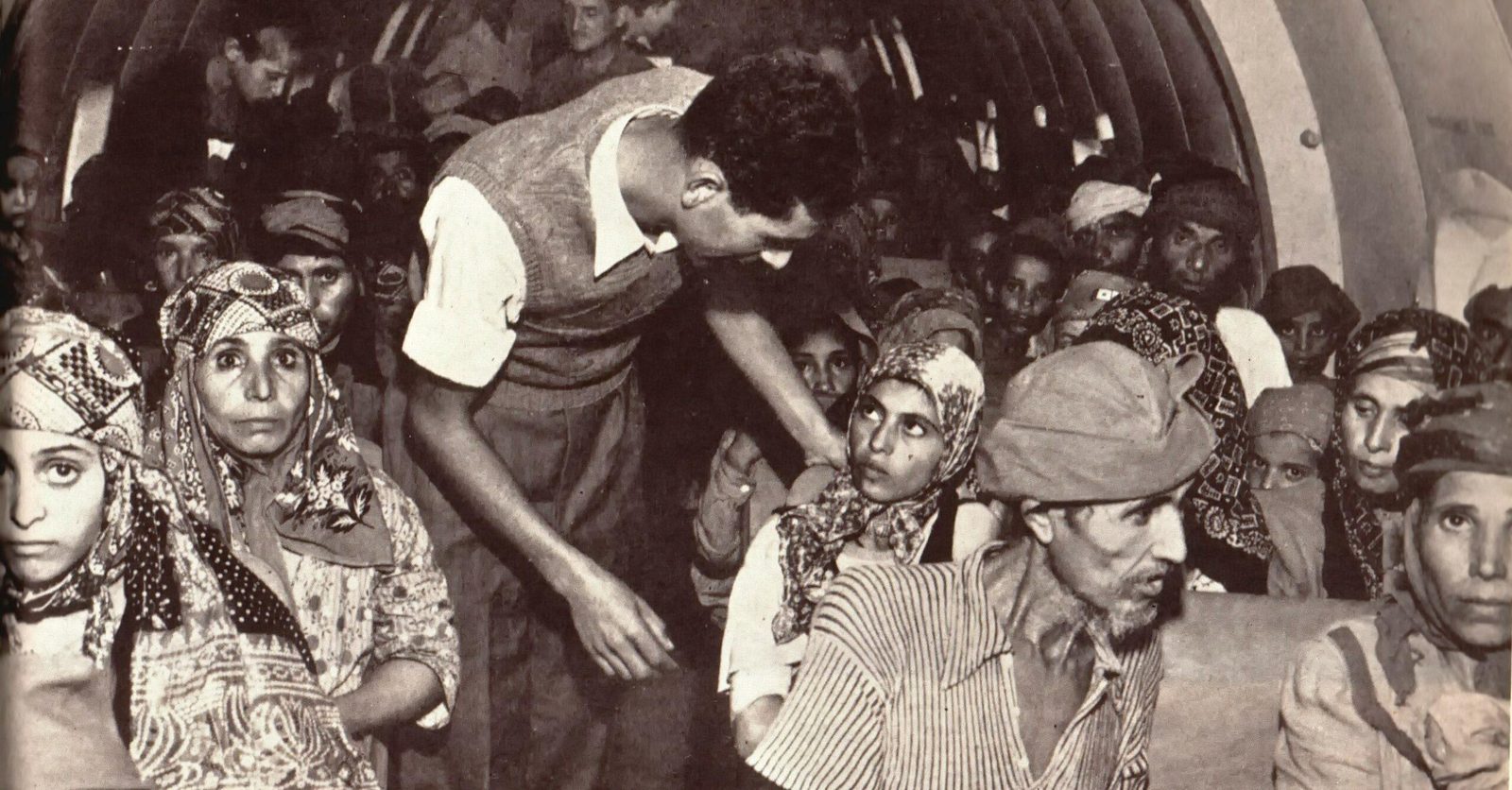
While the Palestinian refugee crisis is widely recognized, far less attention has been given to the approximately 850,000 Jews who fled, were expelled, or were otherwise displaced from Arab countries and North Africa in the decades surrounding the establishment of Israel. Many of these communities predated Islam and had lived continuously for hundreds or even thousands of years.
Following the establishment of Israel, conditions deteriorated rapidly. Anti-Jewish riots, discriminatory legislation, arrests, confiscation of property, and violence led to a mass exodus:
Iraq: Approximately 120,000 Jews left between 1950 and 1952 after persecution, arrests, and confiscation of assets.
Yemen: Nearly the entire community was evacuated to Israel during Operation Magic Carpet (1949–1950).
Egypt: Following the 1948 war and the 1956 Suez Crisis, thousands were expelled or forced to leave, often losing citizenship and property.
Libya: Repeated anti-Jewish riots led to the departure of nearly the entire community.
Syria, Lebanon, Morocco, Tunisia, Algeria: Communities faced increasing restrictions, insecurity, and emigration over the following decades.
Unlike Palestinian refugees, most Jewish refugees were absorbed into Israel or resettled elsewhere and were not maintained as a separate refugee population. Today, only small remnants of these once-thriving communities remain.
The global refugee crisis after World War II
The Palestinian refugee crisis did not occur in isolation. Between the 1940s and 1950s, tens of millions were uprooted worldwide — roughly 12–14 million ethnic Germans expelled from Eastern Europe, an estimated 14–18 million displaced during the partition of India and Pakistan, and millions more across Europe, Asia, and the Middle East.
What made the Palestinian refugee issue unique was not that refugees were created, but that the problem remained unresolved across generations. Most refugee populations of the era were eventually resettled and integrated. Several factors contributed to the different outcome here: the unresolved Arab-Israeli conflict; the fact that — with the exception of Jordan — most Arab states did not grant citizenship to Palestinians; and the framework of UNRWA, established in 1949, under which refugee status could be inherited by descendants. As a result, the number of registered Palestinian refugees grew from several hundred thousand in 1948 to millions today. By contrast, the roughly 850,000 Jewish refugees and their descendants became citizens rather than retaining refugee status.
Historical Sources & References
Benny Morris, The Birth of the Palestinian Refugee Problem Revisited (Cambridge University Press, 2004).
Benny Morris, 1948: A History of the First Arab-Israeli War (Yale University Press, 2008).
Efraim Karsh, Palestine Betrayed (Yale University Press, 2010).
Martin Gilbert, In Ishmael's House: A History of Jews in Muslim Lands (2010).
Norman A. Stillman, The Jews of Arab Lands in Modern Times (1991).
Tom Segev, 1949: The First Israelis.
Bryan Schwartz & Rhonda Spivak, The Conflict Is Not Complicated: The Case for Israel (2025).
Recognizing Palestinian suffering does not diminish Jewish suffering.
Recognizing Jewish refugees does not diminish Palestinian refugees.
A complete understanding of 1948 requires acknowledging all those who were affected, examining the causes of the conflict, and understanding the consequences for every community involved.
Media, Commentary & Public Concern
Palestine Uprooted at the CMHR
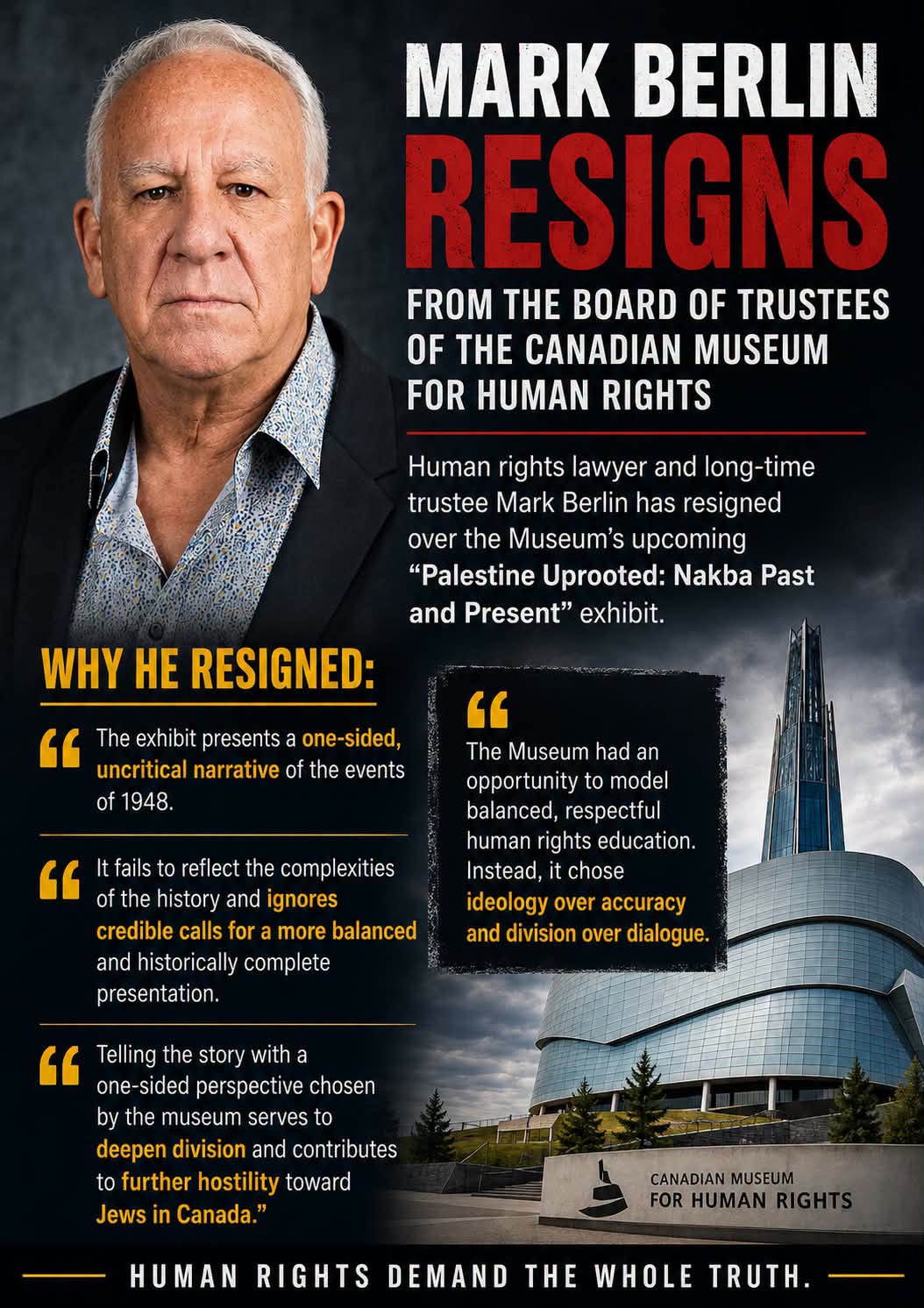
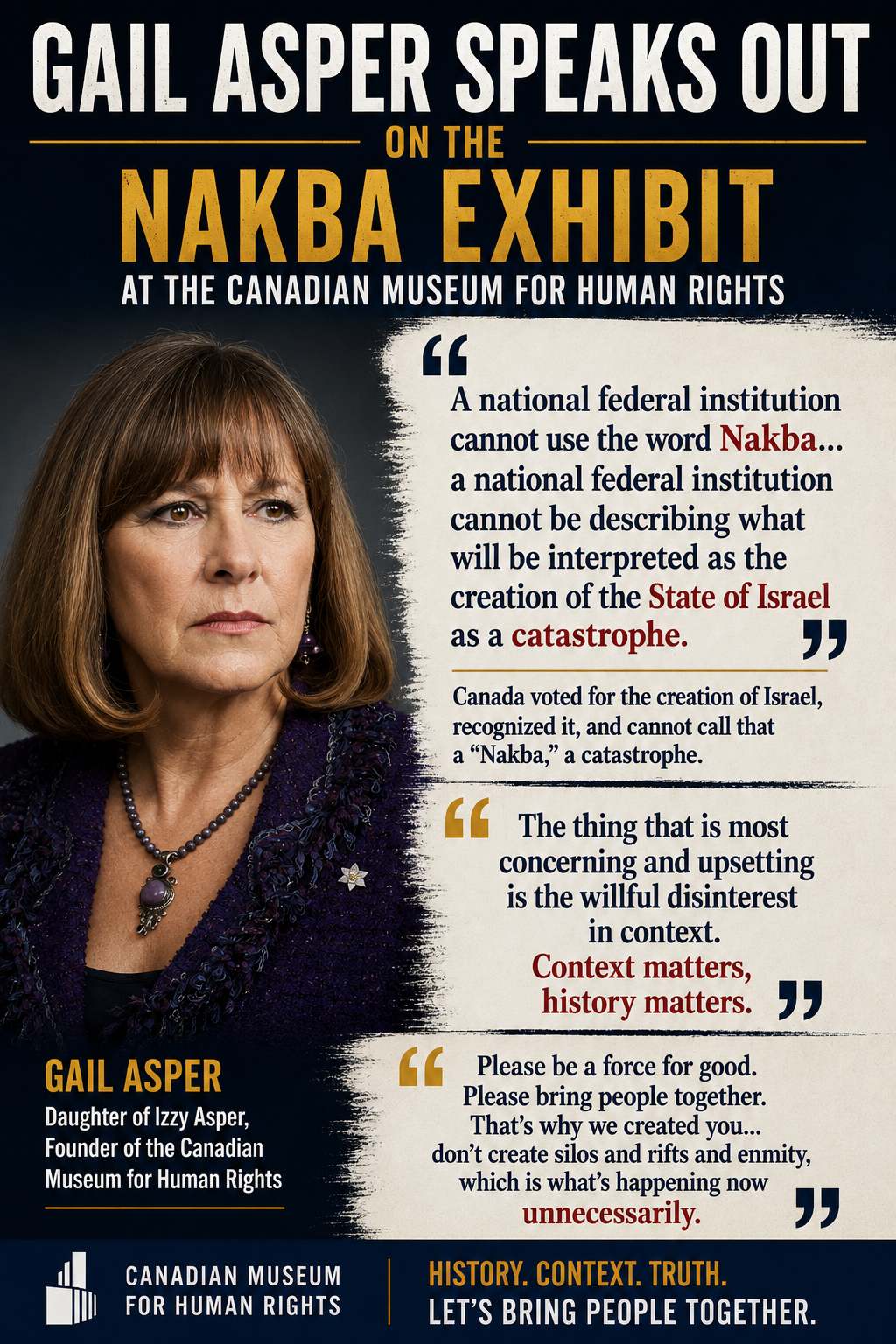
The exhibition has drawn criticism from former museum supporters, legal organizations, journalists, and public figures who argue it presents a one-sided narrative of 1948.
Book: “The Canadian Museum for Human Rights and Its Nakba Exhibit” — Dr. Bryan Schwartz & Rhonda Spivak.
Main Concerns Raised
What critics are asking the Museum to address
Lack of historical context surrounding the events of 1948.
Omission of the UN Partition Plan.
Omission of the Arab rejection of partition.
Limited discussion of the invasion of Israel by neighbouring Arab armies.
Exclusion of displaced Jewish communities from the narrative.
Omission of roughly 850,000 Jewish refugees from Arab countries.
Lack of consultation with Winnipeg's Jewish and Israeli communities.
Whether the exhibit aligns with the Museum's mandate to promote dialogue and understanding.
Take Action
Get Involved
We encourage all Canadians who believe in fair and balanced human rights education to take action. Urge the Canadian Museum for Human Rights to revise or remove this exhibition, share this website with your friends, family, and colleagues, and help ensure that Canada's national human rights museum reflects its mandate of fairness, inclusion, and historical integrity.
Sign the petition: https://bnaibrith.ca/cmhr-demand-accountability/?fbclid=IwY2xjawS3vftleHRuA2FlbQIxMABicmlkETFnb201WWZsU2NOblRwSHQ1c3J0YwZhcHBfaWQQMjIyMDM5MTc4ODIwMDg5MgABHoy1pbPnjESwHFiVKOqqcNwOsx-4LyzYfHHPZs21jT6ohFs1jyWlLWu36U_9_aem_SSqnKHVnQ2cukePO9mHOcw